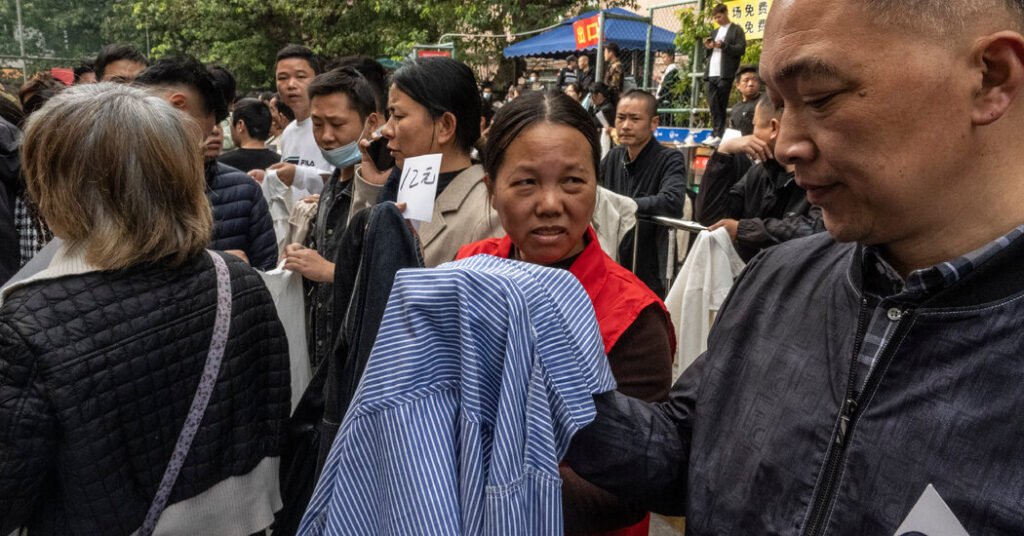

Rows of white concrete structures near the Pearl River in southern China house one of the world's fastest-growing industries: Gritty workshops are churning out low-cost clothing that is exported directly to homes and small companies around the globe. No tariffs are paid, and no customizeds assessments are conducted.The workers who make these goods make just$5 an hour, consisting of overtime, for workdays that can last 10 hours or more. They pay$130 a month to sleep on bunk beds in small rooms above factories loaded with sewing devices and mounds of cloth.”It's effort,” stated Wu Hua, who stitches pants, 7
days a week, at a factory in Guangzhou, a large metropolitan area that straddles the Pearl River.E-commerce giants have actually forged close links from international markets
to employees like Mr. Wu, shaking selling and economies around the globe.The number of duty-free shipments to the United States has actually risen more than significantly considering that 2016, to 4
million parcels per day last year. Similar shipments to the European Union have actually climbed even much faster, reaching 12 million parcels a day last year. Duty-free shipments to developing countries like Thailand and South Africa have likewise surged.Now a worldwide backlash is underway. President Trump bought a halt on Feb. 4 to the duty-free entry, without examination, of parcels with products worth as much as $ 800. Mr. Trump temporarily suspended his order to offer authorities time to develop a plan for dealing with the mounds of parcels that right away started piling up at airports for inspection.Since taking workplace less than a month back, Mr. Trump has released a fusillade of trade actions, consisting of an order on Thursday for his advisors to come up with brand-new tariff levels that take
into account a range of trade barriers. But an enduring halt on duty-free deliveries could be one of the most significant moves. These shipments have actually skirted until now not only his brand-new tariffs, including a 10 percent tax on all products from China, but also many other tariffs that have actually built up over the years.The U.S. action on so-called de minimis deliveries– low-value parcels that customizeds services do not bother examining or calculating tariffs on– was among lots of. Last summertime, South Africa imposed 45 percent tariffs on even the tiniest imports of clothes. Thailand ended its exemption of low-value imported parcels from sales taxes, although it continues to permit tariff-free entry of parcels approximately 1,500 Thai baht ($44 ). And the European Commission, the executive arm of the European Union, proposed this month to end the 27-nation bloc's duty-free treatment of bundles worth up to 150 euros($156). Countries have actually mentioned various factors for their restrictions. Mr. Trump competed that by skirting customs inspections, the duty-free parcels had become a conduit for fentanyl and associated materials to get in the United States. The European Commission mentioned a requirement to make sure item safety in imports, stop fake goods and prevent unjust competitors. South Africa and Thailand acted to safeguard local shop owners.”We have a task to guarantee that products entering our market are safe which all traders regard customers'rights,”stated Michael McGrath, a European commissioner.This corner of southern China near Hong Kong has been a hub of inexpensive production for export considering that the 1980s, particularly apparel. However the rise of e-commerce sellers all over the world has actually developed ever-growing demand of such shipments.Guangzhou has become the worldwide hub of de minimis shipments. Across lots of square miles of the city, fast fashion garments are made in concrete structures with sewing shops, and often living quarters above them.Shein and Temu, competing Chinese e-commerce giants that together hold at least a third of the de minimis industry, coordinate much of their supply chains from large workplaces in Guangzhou. Amazon has actually introduced its own de minimis company, Haul, for deliveries from China.China's de minimis market is not confined to Guangzhou. Nor is it limited to the industry's essential, clothing.Yiwu, a city 600 miles northeast of Guangzhou with a large wholesale market, has actually become another center. It collaborates de minimis exports of toys, hats and other little items from towns spread across the Yangtze River delta.Shein, in particular, has actually emerged as a new company principle, linking remote consumers with factories prepared to cut and stitch almost anything. Working together with 5,000 workshops and small factories across China, Shein's method practically entirely gets rid of the need for shop stock, or perhaps for shops and retail personnel.”At Shein, we have reimagined the
supply chain by empowering thousands of little and medium-sized companies, giving them full insight into what our consumers desire and
require,” the company states on its website.But workshop owners in Guangzhou grumble that Shein is too demanding.Li Zhi's workshop produced garments for a Shein professional four years back, but the arrangement lasted just a year.” Shein requires high quality but uses low
prices, “she stated while sorting lace fabric on a table.She now offers instead to wholesalers for China's domestic market, who offer her greater rates. But business remains difficult, she said, as a scarcity of blue-collar workers has actually sent out the going rate for a day's labor to practically$70, from$48 four years ago.In China today, almost
two-thirds of 18-year-olds register in a college or university, up from 10 percent in 2000. That has actually left few young Chinese willing to do factory work.”Business is deteriorating every year,”Ms. Li said.
“There are fewer and less workers now– primarily those born in the '70s and '80s.”If Mr. Trump completely ends the de minimis guideline, imported apparel that is now duty-free would undergo basic tariffs of 3 to 30 percent, plus a 7.5 percent tariff imposed during his first term, plus a 10 percent tariff on all
imports from China that the president troubled Feb. 4. On top of that, there would be customizeds processing fees of$5 to $20 per parcel.Shein said its suppliers paid their workers twice as much as local minimum incomes. Temu said nearly 60 percent of its sales in the United States were now from American warehouses with shipments that go through customs, with tariffs paid.The competitive advantages of the de minimis export market in China exceed avoiding tariffs and
skirting custom-mades examinations. More than 90 percent of China's cotton is grown in Xinjiang, an area in China's far northwest
. Numerous Western governments have actually begun restricting or prohibiting imports with any material from Xinjiang after mass arrests there by China's security firms and proof of forced labor among the region's predominantly Muslim ethnic groups, especially the Uyghurs. Homes and small businesses that purchase de minimis parcels from China bear legal obligation for ensuring their parcels have no cotton or other content from Xinjiang. However regulators in the West have actually been reluctant to bring charges.Big sellers, by contrast, typically comply with Xinjiang-related legislation when they import large shipping containers of clothing for their stores.Workshop owners in Guangzhou said they did not understand where their material suppliers got their cotton.Yun Congping, a Guangzhou sewing store owner who supplies the Thai market, said he and other merchants required exports. “If we don't accept the offers “to supply inexpensive exports, he stated,” there's absolutely nothing else to do.”Jordyn Holman contributed reporting from New York. Li You contributed research. Source