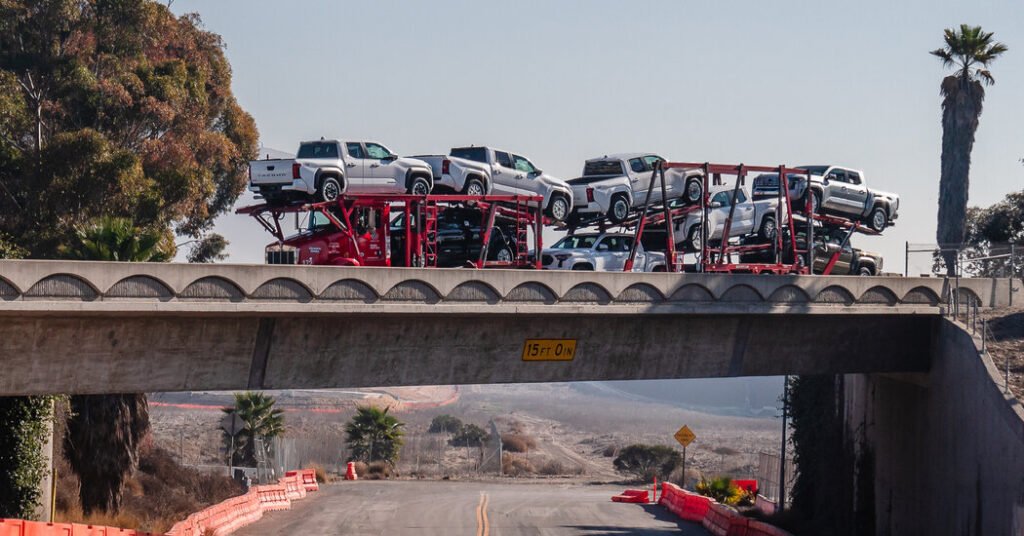

Car manufacturers can respond to President Trump's brand-new 25 percent tariffs on imported vehicles and parts in a number of methods. However all of them cost cash and will lead to higher automobile rates, experts say.Manufacturers can attempt to
move production from nations like Mexico to the United States. They can attempt to increase the variety of cars and trucks they already make here. They can stop offering imported designs, especially ones that are less profitable.But whatever carmakers choose, car buyers can expect to pay more for brand-new and used automobiles. Estimates vary extensively and depend on the model, but the boost could vary from around$3,000 for a car made in the United States to well over$10,000 for imported models.Those figures do not take into account additional tariffs that Mr. Trump stated he would reveal next week to penalize countries that impose tariffs on U.S. goods. He has also stated he would increase tariffs further if trading partners like Canada and the European Union raise tariffs in reaction to his car tariffs, leading to an intensifying tit-for-tat trade war.” It's going to be disruptive and costly for American customers for numerous years,”stated Michael Cusumano, teacher of management at the MIT Sloan School of Management.Mr. Trump has actually long brandished tariffs.
However numerous auto executives had hoped that his threats were a working out tool. Mr. Trump rushed those hopes on Wednesday when he stated at the White Home that the tariffs were”one hundred percent”permanent.Mr. Trump framed the tariffs as a way to bring vehicle manufacturing back to the United States. The United Automobile Employees union concurred, stating car manufacturers could resume plants in locations like Lordstown, Ohio, or expand production in cities like Warren
, Mich., where vehicle workers have been laid off.”It is now on the automakers, from the Big Three to Volkswagen and beyond, to revive good union jobs to the U.S.,”Shawn Fain, the U.A.W. president, stated in a declaration Wednesday, describing General Motors, Ford Motor and Stellantis, owner of Chrysler, Jeep and Ram.But moving factories is pricey and time consuming. Carmakers typically need at least 2 years to set up a brand-new assembly line and make sure that the automobiles it produces meet quality standards. To completely avoid tariffs, they would also need to relocate devilishly made complex supply chains
that typically involve suppliers in lots of countries.Tariffs might encourage companies to choose areas in the United States rather of Mexico or Canada when they are contemplating where to expand production or develop a new model. But picking a site due to the fact that of tariffs, and not since it is the most effective place to manufacture, would come at a cost to consumers.Some business may be reluctant to make those decisions, which can cost hundreds of countless dollars, since they stress that Mr. Trump, despite assurances to the contrary, may change his mind. Or the next president could reverse his tariffs.”What we hear from a lot of customers is,'How do we justify that capital investment without understanding if this is a long-term procedure?'”said Kevin Williams, a senior director at the law office Clark Hill who concentrates on trade.”You make that investment and 2 years from now they state,' Never ever mind.'”Carmakers, numerous of which decreased to comment, will probably avoid handing down the entire cost of the tariffs to customers. If they raise prices excessive, sales might plunge, causing a death spiral of sinking profits and increasing expenses. Economic experts fret that the financial disruption triggered by tariffs might assist provoke a recession.Some carmakers have actually been stockpiling parts and finished cars before tariffs kick in, but that will hold down costs just for a while.”Tariffs are just going to make individuals pay more for cars and trucks, and people will buy fewer automobiles,” stated W.C. Benton, a teacher of operations and supply chain management at Ohio State University.New automobiles are currently beyond the reach of numerous Americans– the average sale price these days is more than $48,000, according to Cox Automotive. Prices of utilized vehicles are likewise expected to rise, as they did during the pandemic, as more purchasers look for affordable options.Most car manufacturers are not exceptionally successful and have actually restricted monetary space to maneuver.
General Motors, which is among the more profitable business, had a net profit on sales in 2015 of 3.2 percent. As an outcome, carmakers will need to pass much of the cost of tariffs on to their customers.If so, tariffs could add$15,000 to the cost of a Ram 1500 pickup, almost$12,000 to a Toyota Tacoma pickup,$9,000 to a Subaru Forester S.U.V. and $6,000 to a Nissan Sentra sedan, according to quotes by iSeeCars, an online automobile buying site.Some carmakers are currently raising rates. Ferrari, whose Italian-made sports cars sell for hundreds of countless dollars, stated Thursday that it would increase rates by as much as 10 percent on some models in response to tariffs.Automakers may stop selling some less profitable designs, which tend to be smaller sized and more budget-friendly. They will promote domestically made vehicles and trucks, many of which are bigger and more pricey. All major carmakers, including foreign brand names like Mercedes-Benz, BMW, Volkswagen, Honda and Toyota, have big factories in the United
States.But no automobiles will be exempt from tariffs due to the fact that all have foreign-made parts, which usually represent a minimum of a third of the automobile's value. That part will be subject to a 25 percent tariff, according to the Trump
administration.”There's no such thing as an American car, “said Simon Geale, an executive vice president at Proxima, a consulting company that encourages business on procurement.Some carmakers may prevent making big changes to their operations in action to the tariffs, betting that the repercussions will be so extreme that the Trump administration will have to backpedal.
“There's going to be an amazing backlash from American customers, “said Mr. Cusumano of M.I.T.”I would hope there would be some action to that.”Ana Swanson contributed reporting. Source