
Shares in automakers around the world wobbled on Thursday after President Trump announced plans to enforce a 25 percent tariff on imported automobiles and some parts beginning next week.The stocks of major Detroit carmakers, which develop some of their cars in Canada and Mexico, were rattled on Wall Street. Shares in General Motors, which imports many of its very popular vehicles and trucks from Mexico, tumbled more than 7 percent. Ford, which is less reliant on imported vehicles, fell nearly 4 percent, extending its losses from earlier in the day, while Stellantis’s stock– the parent of Chrysler, Fiat, Jeep, Peugeot and Ram– was more than 1 percent lower for the day.The turmoil was concentrated in the auto sector, with the more comprehensive
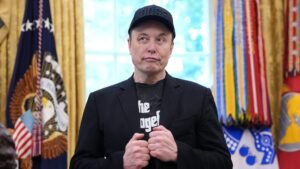
S&P 500 index trading roughly flat before ending the day down 0.3 percent.But shares in Tesla, which is anticipated to suffer less from tariffs than its competitors due to the fact that it makes all the vehicles that it sells in California and Texas, rose about 0.4 percent on Thursday. Mr. Trump stated on Wednesday that Elon Musk, Tesla’s chief executive who has taken a leading function in the White Home, had not affected his decision to impose tariffs.Among the hardest hit shares on Thursday were those of carmakers based in Germany, Japan and South Korea, which sell a lot of their cars and trucks in the United States and rely on intricate supply chains that cross borders, consisting of from production sites in Mexico and Canada.Earlier in the day, shares in the German car manufacturer Volkswagen, Europe’s biggest, fell 1.5 percent. Other German carmakers like Mercedes-Benz and BMW dropped 2 to 3 percent in European trading.The stocks
of the Japanese companies Toyota Motor, Honda Motor and Nissan Motor fell about 2 percent in Tokyo. Shares in Hyundai Motor and Kia, both based in South Korea, fell 3 to 5 percentin Seoul.Shares in Tata Motors of India plunged 5.5 percent. The carmaker owns the British business Jaguar Land Rover, which imports all of the luxury
automobiles it offers in the United States. The German automobile maker Porsche, whose stock dropped 2.5 percent, likewise imports all the automobiles it sells in America.Nearly half of all lorries offered in the United States are imported, along with almost
60 percent of the parts in cars assembled there. For many foreign carmakers, the United States is a vital market: Nearly one of every 3 Porsches, and one of every six BMWs, are shipped there. German business also export about$8 billion in automobile parts to the United States.”Because all countries in the world
are affected, it is likely to be tough for countries like Germany to reroute automobiles to third nations and sell them there,” analysts at Commerzbank wrote in a note.BMW warned this month that it expected that trade conflicts could cost the business $1 billion this year.The slump in vehicle stocks took down benchmark stock indexes in big exporting countries. The German DAX index fell nearly 1 percent, while the South Korean KOSPI
dropped 1.4 percent. In Japan, the Nikkei 225 closed 0.6 percent lower.There were indications of jitters in other markets. The price of gold, which has actually been setting records as investors sought a haven from trade and geopolitical uncertainty, leapt more than 1 percent, approaching $3,100 per ounce. Experts at Goldman Sachs raised their forecast, saying they anticipated gold to hit$3,300 by the end of the year.U.S. Treasury yields ticked greater, as traders considered the inflationary effect of the tariffs, which might include countless dollars to the cost of imported vehicles. The yield on 10-year bonds rose slightly, to about 4.37 percent.Along with Mr. Trump’s new tariffs, financiers weighed data launched on Thursday showing that the U.S. economy stays healthy. Preliminary applications for welfare inched down last week, the Labor Department reported, a sign that the labor market is still strong. The Commerce Department also revised up gdp development for the last 3 months of 2024, to a 2.4 percent annualized rate, up from the department’s previous 2.3 percent estimate.On Wednesday, Mr. Trump said he anticipated the auto tariffs to be long-term. Still, lots of financial experts think that the economic damage might be so severe that the tariffs would be downsized.”We believe it is unlikely that the brand-new tariff program will last, given the prevalent damage they will do throughout markets and the inflationary impact on the U.S. economy, “analysts at Bernstein wrote.But financiers have recently been shocked by the administration’s aggressive trade approach, which likewise consists of steep extra tariffs on all U.S. imports of items from China and a large share of goods from Canada and Mexico. Mr. Trump and his advisers have stated that an economic crisis is possible, stressing that the short-term discomfort would deserve it in the long term.”It is tough to judge the duration of such chainsaw-like policies if these cause a market depression that does not seem temporal, “the Bernstein experts included. Source