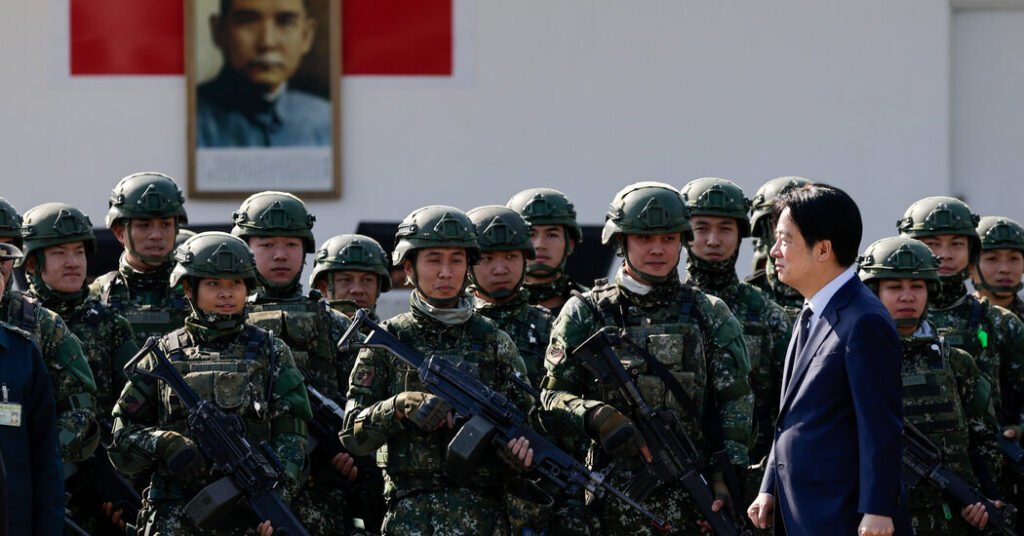

Not so long earlier, Taiwan basked in relatively boundless, bipartisan support in Washington, where the island has long been considered a valiant democratic partner against China.Now, a couple of weeks into President Donald J. Trump’s 2nd term, Taiwan is getting used to a shift in its relationship with the United States, its primary backer– one that does not focus on shared democratic suitables, and that is more unsure and transactional. Mr. Trump has actually implicated Taiwan of spending far insufficient on its own security and of gaining an unfair dominance in making semiconductors.Taiwanese officials and businesspeople have actually been trying to ensure the new administration of their dedication to cooperation. They have traveled to Washington for meetings, bearing charts detailing their military expenses, and attended inauguration events filled with the MAGA faithful. They have actually floated brand-new deals that Taiwanese companies might broker with American services in gas and other fields, and attempted to discuss the value of Taiwan’s semiconductor manufacturing to American interests.Underlying their efforts is an anxiety over what Mr. Trump might do, for example, to press Taiwanese
business to move advanced semiconductor production to the United States. Mr. Trump has actually stated he may soon impose tariffs on semiconductors. Taiwanese authorities have actually been preparing to help Taiwanese businesses soften the blow of any such relocation.”I think Taiwan just convinced itself that they had good relations with the U.S. and they had lots of pals in Congress, and they would have the ability to weather the storm,” said Bonnie S. Glaser, the managing director of German Marshall Fund’s Indo-Pacific program, who frequently talks with Taiwanese political leaders. “When Trump made those remarks, I believe it was an awaken call for people in Taiwan that they actually didn’t know what was following.”Federal governments worldwide are trying to adjust to Mr. Trump’s combative approach. However the stakes for Taipei are specifically high. The island depends on the United States for almost all its major weapons. It sends nearly a quarter of its exports directly to the United States, and Washington is vital in providing Taiwan political assistance against Beijing, which claims that Taiwan is its territory and must accept unification– by force, if considered necessary.Taiwanese officials and policy advisers said the island would rapidly present measures to assist its businesses harmed by any new U.S. tariffs. They spoke on condition of anonymity since of the sensitive and provisional nature of the plans, and declined to offer information. Some authorities have openly meant the preparations.”We’re getting ready for a variety of scenarios,”the minister of financial affairs, Kuo Jyh-Huei, informed press reporters when asked about Mr. Trump’s threatened tariffs.”If we showed our hand now, that would not work to the benefit of everybody.”Even if Mr. Trump holds back on the tariffs, Taiwan deals with more pressure from his administration on other concerns. They include the island’s big trade surplus with the United States, which climbed to a record $74 billion last year according to U.S. data, and its military spending and preparations, which numerous in Washington view as doing not have, even though billions of dollars worth of orders of American military equipment are stuck in a backlog. The United States is committed by law to assist Taiwan defend itself, and exposes the possibility of intervening militarily if China attempted to dominate the island.” There’s a fundamental mismatch. We have actually been thinking that America and Taiwan are in a strong collaboration, but America under Trump believes Taiwan doesn’t do enough,”stated Jason Hsu, a former Taiwanese legislator and technology investor who is now a senior fellow at the Hudson Institute.”Eventually, the Taiwan government will need to show up intown with a bundle ready to provide Trump.”Openly, the Taiwanese government is predicting calm confidence about relations with Washington. However Taiwanese officials’efforts to construct bridges into Mr. Trump’s inner circle during trips to Washington last month and in December, have actually yielded little bit so far, stated three American officials familiar with their attempts, who described the interactions as limited.Taiwan sent out two economic officials to Washington this week to “much better explain ourselves to Mr. Trump’s circle,”Mr. Kuo, the financial affairs minister, told press reporters before their departure. Taiwan likewise intends to purchase more melted natural gas from Alaska, he has said.”Taiwan is preparing some presents for Trump,”stated Jeremy Chih-Cheng Chang, the president of the Research Institute for Democracy, Society and Emerging Technology in Taipei.”
They have actually currently indicated some, as you have actually seen in report– like buying liquefied natural gas– but there make sure to be others.” In January, executives from Taiwan Semiconductor Manufacturing Business– TSMC, the world’s most advanced chip maker– held talks with Mr. Trump’s candidate for commerce secretary, Howard Lutnick, said several individuals familiar with the talks who spoke on condition of anonymity. In December, Taiwanese authorities going to Washington showed authorities and Republican politicians a presentation developed to show that Taiwan has been quickly increasing military preparations, according to people knowledgeable about those conversations. They met with Michael Waltz, then a Florida congressman known for being hawkish on matters of national security, according to one of the people.Taiwanese authorities remain hopeful that they will find robust fans in 2 males who were deeply vital of China in Congress: Marco Rubio, the secretary of state, and Mr. Waltz, now Mr. Trump’s national security adviser. But some previous officials who highly supported Taiwan in Mr. Trump’s first term have notbeen brought into his brand-new administration, consisting of Mike Pompeo, the former secretary of state. “It’s really telling that some hard-line hawks on Taiwan have actually been overlooked,”stated Christopher K. Johnson, the president of China Strategies Group, a consulting firm, and a previous U.S. federal government intelligence officer.” It appears like Taiwan bank on some of the incorrect horses.”Half a lots or two authorities poised to take senior positions in the Pentagon have actually rejected the G.O.P.’s tradition of backing an extensive foreign reach, in favor of limiting U.S. military dedications abroad. They represent an ascendant foreign policy teaching in a celebration that in the last few years has chafed at devoting more military assistance to Ukraine, and pressed NATO allies to spend more on their militaries.In a viewpoint essay released last Might, Mr. Trump’s candidate to serve as the Pentagon’s under secretary of defense for policy, Elbridge Colby, warned that Taiwan must not presume that it was important to the United States.”America has a strong interest in defending Taiwan, however Americans could make it through without it,”he wrote. He and other Pentagon officials have suggested that Taiwan should increase its military spending to at least 5 percent of its financial output, or about two times what it presently is spending.The Taiwanese government has said it is devoted to expanded military costs, though many Taiwanese experts and authorities, privately, question the 5 percent target.
President Lai Ching-te of Taiwan likewise faces a legislature managed by opposition legislators who have actually accused his government of inefficient costs and checked parts of this year’s defense budget.At the same time, Taiwan has its ownfrustrations with the United States, including the big stockpile of undelivered orders of arms and military equipment to the island.”I do pick up a pain of being informed to spend more when they haven’t received what they’ve already paid for,”said Steve Yates, a senior research study fellow at the Heritage Foundation, describing Taiwan. “The U.S. needs to fix its defense producing supply chain before it can fairly put pressure on others to do and buy more.”Ana Swanson in Washington, Amy Chang Chien in Taipei and Tripp Mickle in San Francisco and Whistler, British Columbia contributed reporting. Source